
The Tentative Heart
Story by: Luke Bonanni & Carol Zapata-Whelan
Art by: Leon Axel & Barbara Kerstetter
2025
Being early in my medical career, wondering what it means to leave a legacy is a dizzying question. “The Tentative Heart,” a collaboration between myself and medical and artistic professionals who have crafted legacies of their own, explores how a young physician might shed feelings of hesitation and follow his interests, wherever they may lead.
Swish, swish, swish, swish, swish… SPLAT.
“Ah, geez…” I said as a glob of red paint slid down the beige wall, leaving a crimson streak. I had added this red river to a sea of intersecting lines and colors spanning the northeast wall of the cardiac ICU’s family room.
“Woah, John, that red sure adds to your section of the mural!” joked my friend Emma as she wiped flecks of paint from her thick-rimmed glasses. “I hope you bragged about your artistic capabilities during residency interviews.”
In a few weeks, Emma and I would open Match Day envelopes, revealing our medical residency assignments. To take our minds off our futures, we volunteered to paint a mural at the city hospital. But as I struggled to wipe my paint mistake off the wall with a wet rag, it felt like I had traded one stressor for another.
“Beauty is in the eye of the beholder,” I said to Emma. “But I am beholding a cacophony of chaotic colors.”
“At least your residency program will be impressed by your alliterative abilities,” Emma responded, her brown eyes squinting with amusement.
With the mention of “residency,” my chest began to swell with anxiety. Residencies advertised their opportunities for research, teaching, advocacy, innovation, and subspecialties. To me these represented uncharted oceans, an exciting call to adventure. But I also feared drowning. How would I know which course to navigate? What would I leave behind?
“It will all make sense eventually...” said Emma, gazing at the mural.
I wanted to believe her.
Match Day came and went before I knew it. A late winter virus kept me home, leaving Emma to put the finishing touches on the mural. Before long, I found myself in another cardiac ICU--this time as a resident in a large regional hospital near my medical school--though my mind was light years away from the mural. As I closed out the plan for my last patient on rounds, I gazed down the hallway of stainless steel columns and glass doors that seemed to stretch endlessly into the distance.
Suddenly, I heard my attending, Dr. Joseph Morris, the cardiac intensivist, his voice booming over the ever-present beeping of cardiac monitors. “We could use your help!” he exclaimed, his bushy eyebrows rising high on his forehead. As intense as he was renowned, Dr. Morris was offering me a golden opportunity to join his research project on a new circulatory support device. How could I even think about turning down this chance? But the offer was coming at me during the hardest time of my life as a doctor so far: 28-hour shifts; no time to eat, sleep, breathe. And if I joined Dr. Morris, what if a better offer arose?
I could feel that old medical school anxiety rise up, the fear of not being enough. I shoved it down as far as it would go, and headed to the bedside of a patient who had better reasons than I did to fear the future.
“I seem to be popular lately!” my elderly patient, Gloria, greeted me as I slid open glass door to her room. Gloria’s frail body blended into the pale bedspread. Her eyes and cheeks were sunken; her head unable to lift from its pillow. Her raspy voice seemed to come from anywhere but within her, giving the room a haunted feeling.
“You’ve had a lot of staff coming in because we’re a bit worried about you right now,” I said gently. “The heart medications we’re giving you don’t seem to be enough. So, we need to make some adjustments. We’re going to keep taking excellent care of you.”
Gloria did not look anxious over my news. “You don’t need to worry,” she said. “I know I’m dying. Not being able to get a heart transplant and all.”
Silence permeated the room, interrupted only by the rhythmic beep of the heart monitor. I placed my hand on Gloria’s shoulder.
“Don’t feel sorry for me, Doc,” she reassured me. “You know, I’ve written scenes like this so many times.” Her sunken eyes moved over leads and monitors, past a whiteboard with staff instructions. "I know what’s coming.”
“You wrote for a newspaper, right?“ I said, remembering a prior conversation. “Did you do obits?”
“Since you asked,” she said companionably, “I’ll tell you about my life—but no complaining, you hear?”
I glanced discreetly at the ever-expanding inbox on my phone, no time for long stories.
“News was a great job,” said Gloria, before I could take my leave. “But I always wanted to be a novelist. When I was a girl, I loved the library. I read all the greats. I was going to be a Dickens, a Hemingway, maybe a Kafka. I had plenty of stories in my head. And I wrote outlines, dozens of them.”
Gloria paused; eyes bright.
“But I never believed that what I wrote was good enough.” Her frail shoulders traced a shrug. “I kept looking for a better idea. A better story. I wanted to find the perfect words. ‘Le mot juste,’ as Flaubert called it.”
Gloria stopped to gather in air to speak. The little window in her room framed twilight.
“I thought I would have more time,” she said, without self-pity.
Gloria seemed to accept that she was running out of time.
But I realized at that moment that I did have more time. At least, more time than I ever thought I had as a resident. So, I pulled up a chair alongside Gloria’s bed.
With each visit, I listened to as many stories as Gloria had the time and breath to share. The perfect words she never found, the stories she would never publish because of her failing heart. They would live on in my heart.
That first night I listened to Gloria’s story, I found the time to write something important myself. “Good evening, Dr. Morris,” I said in an email that would change my own life story. “I would be thrilled to join your research project…”
Gloria passed away. In what felt like no time at all, I graduated residency and stayed on as a chief resident. I continued to work with Dr. Morris on various research projects. And before I knew it, I was back at my medical school’s city hospital for a conference. On a whim, I decided to head back to the cardiac ICU to check out the wall of abstract art that my friend Emma and I had worked on in med school.
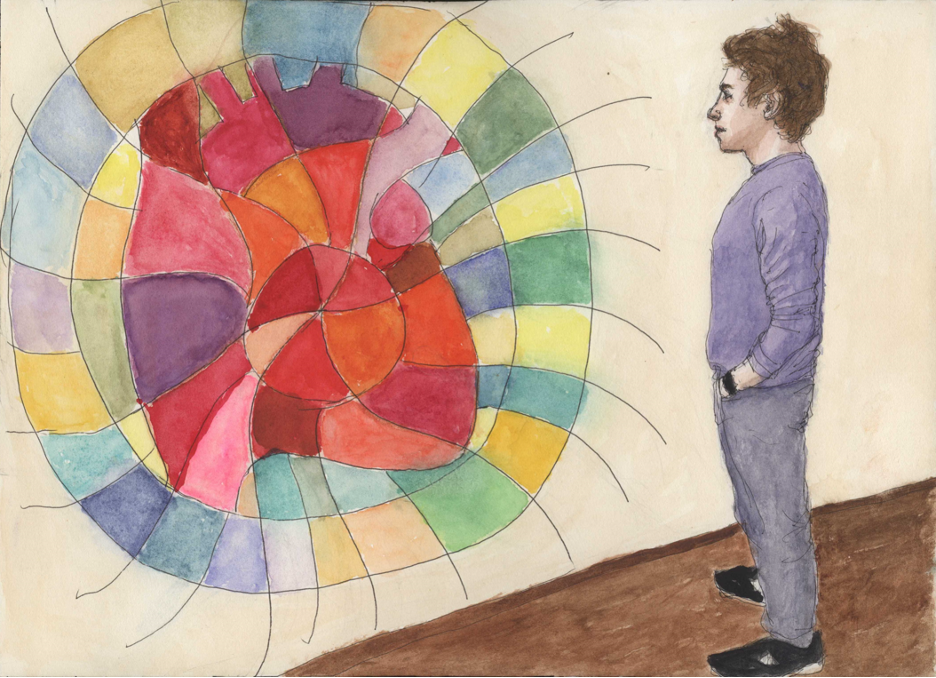
I gasped when I saw the mural. From the inscrutable lines and colors emerged the image of a radiant heart. Families on their way to visit their loved ones paused now and then to admire the mural and its colors. Even my wayward red line became part of the beauty when seen as a whole. And in the corner of the mural, I saw my name, along with Emma’s and the rest of the crew.
A feeling of satisfaction welled up inside me. Leaving something behind that could comfort people dealing with hardship, that was meaningful. This satisfaction crowded out the old anxiety in my heart. In a flash of understanding, I accepted that meaning is made through service, service as small as brushstrokes on a wall, as grand as collaborating on the next big treatment, or as quiet as listening to a tentative heart. And that whatever I do in this vein will leave a worthy legacy. Because life’s chaotic lines and colors can make sense—in time.